
Last updated October 16, 2026
 Water damage drying
 Fire & smoke cleanup
 Mold remediation
 Storm response
 Sewage cleanup
 Reconstruction
Free visual inspection and a written scope of work before any mitigation begins - photos, moisture readings, and drying logs go in your claim file
The scope we write is the scope we bill. Anything new gets shown to you, in writing, before we touch it.
Get your free estimateDamage Restoration Warning Signs: A Orlando Homeowner’s Reference Guide
Most Orlando homeowners don’t get a dramatic flood announcement before water damage takes hold. They get a baseboard that looks slightly darker than it did last spring, a door that catches on the bathroom tile in August, or a faint smell they’ve convinced themselves is just “Florida humidity.” We’ve walked into hundreds of Orlando homes where a $600 repair had quietly grown into a $9,000 restoration because the early signals were rationalized away for twelve months or more. This guide lays out the specific warning signs that show up in Central Florida homes, where to find them, and what they actually cost when they’re ignored.
Restoration work we handle
Quick Answer
The most reliable early warning signs of water damage in Orlando homes are: active water staining on walls or ceilings with soft edges or bubbling paint, efflorescence (a white chalky film) on block or masonry walls, grout and caulk failures in showers and tubs that stay wet, floor cupping or door-binding that gets worse in humid weather, and a persistent musty odor that isn’t solved by opening windows. In Orlando’s climate, a musty smell that “goes away” after airing out the house is almost always active mold growth in a wall or floor cavity, and the warm humid air moving through the house when windows are open actually feeds that growth rather than fixing it.
Table of Contents
- Old Staining vs. Active Intrusion: Reading the Difference
- Grout and Caulk Failures: What Normal Aging Looks Like vs. What Signals Water Behind the Tile
- Floor Cupping and Door-Binding: What Those Timelines Tell You
- AC Performance Drops: A Hidden Moisture Indicator
- What You Can Measure Without Specialized Equipment
- Orlando-Specific Warning Signs Homeowners Miss
- What These Signs Cost When Ignored
- Common Mistakes to Avoid
- When to Call a Professional
- Frequently Asked Questions
Old Staining vs. Active Intrusion: Reading the Difference
The single most useful skill an Orlando homeowner can develop is telling the difference between a historic stain and an active leak. They look similar at first glance, but the edges tell the story. An old water stain, one that happened years ago and dried completely, has a crisp brown ring like the edge of a coffee mug on a napkin. The boundary is sharp, the color is uniform, and nothing changes when the humidity rises. An active moisture intrusion is different. It has a soft, feathered edge that fades gradually into the surrounding surface. The paint might be bubbling, peeling, or showing tiny blisters. If the staining is on a block or masonry wall, look for efflorescence, a white chalky powder that forms when water moves through concrete and deposits mineral salts on the surface. In Orlando’s block-construction homes, efflorescence is one of the earliest and least understood indicators of an active water path behind the wall.
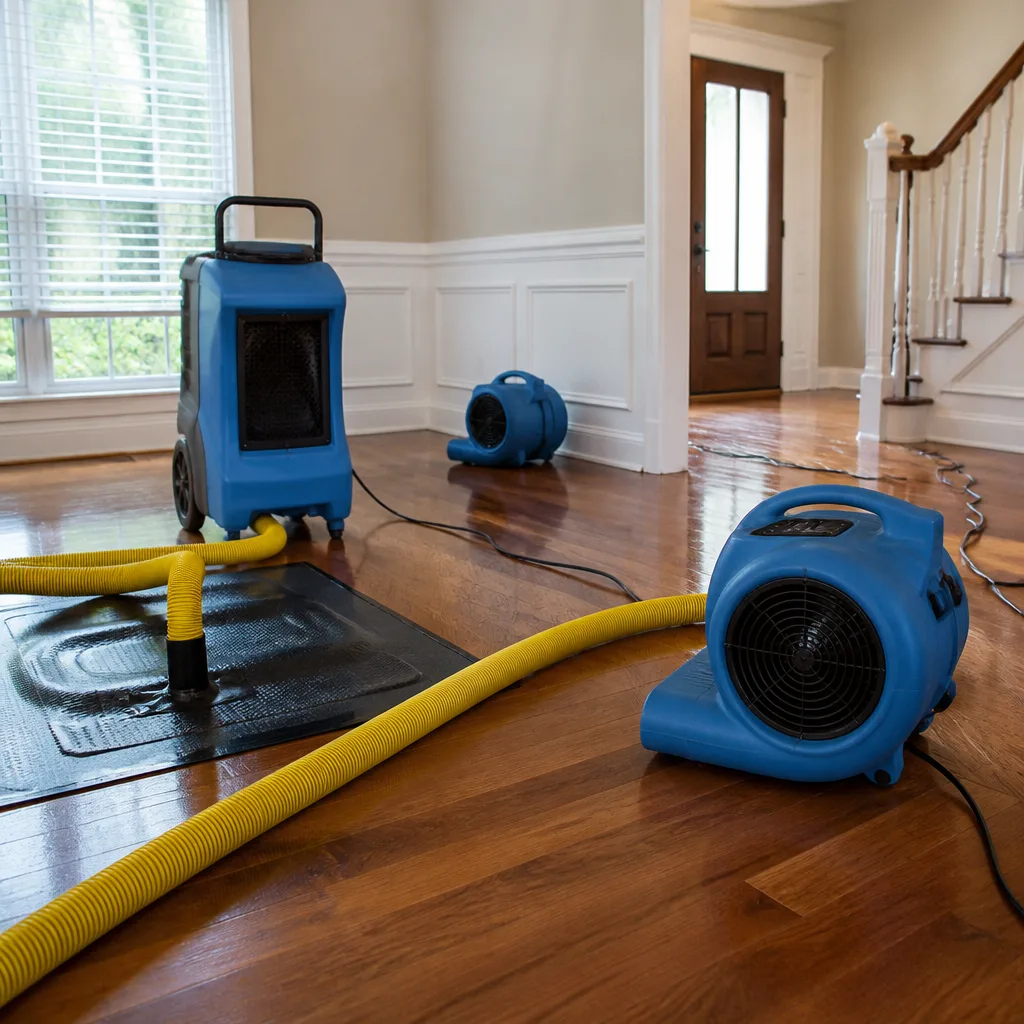
The reason this distinction matters comes down to cost. Old staining is cosmetic; it can be primed and painted. Active intrusion means water is still traveling through the building material right now, and every week it continues, the repair scope grows. In our experience across Orlando, homeowners who call about a “small stain” that turns out to be active typically need drywall removal and drying on one side of the wall, not just a patch. The drying alone uses professional equipment because Central Florida’s ambient humidity is often above 60 percent, which is too high for building materials to dry on their own. That’s one of the reasons Water Damage Restoration in Orlando requires industrial air movers and dehumidifiers rather than box fans and open windows.
What to Check Monthly
- Look at the ceiling directly under any bathroom on the second floor. Even a tiny amount of persistent dampness shows here first.
- Examine the baseboards along exterior walls after heavy afternoon thunderstorms. Darkening at the bottom edge is a red flag.
- Check block walls in garages and utility rooms for white chalky deposits. Wipe one spot clean; if the powder returns in a few weeks, water is actively moving through the block.
- Run a hand along walls near windows after rain. Feeling coolness that doesn’t match the rest of the wall can indicate moisture behind the surface.
Grout and Caulk Failures: What Normal Aging Looks Like vs. What Signals Water Behind the Tile
Grout and caulk don’t last forever, and some deterioration is expected. Normal aging looks like surface-level cracking in caulk at the corners of a shower, or grout that’s slightly recessed from years of cleaning. These aren’t emergencies. But when grout in a shower or tub surround stays dark after it’s been dry for hours, or when caulk peels away from the tile in strips rather than cracking in place, that’s a different situation. It means water has found a path behind the tile and is saturating the substrate, the backer board or mud bed that holds the tile in place. In Orlando, where showers are used at least once daily and the ambient air is consistently humid, a failed shower pan or torn corner caulk can keep a wall cavity perpetually damp.
The expensive version of this problem is not the tile work itself. It’s what happens behind the tile. A saturated substrate supports mold growth, rots the framing, and eventually causes the tile to loosen or the grout to crumble out in chunks. By the time a homeowner notices a few tiles sounding hollow when tapped, the damage has typically spread beyond the shower footprint. The repair of a shower pan leak that’s gone unaddressed for a year routinely involves removing the bottom rows of tile, replacing the substrate, and rebuilding the pan. That’s a multi-thousand-dollar job compared to a re-caulking that takes two hours. The warning sign is consistent: caulk that won’t stay adhered, grout that stays dark, or a musty odor that’s strongest in the bathroom even after cleaning.
Floor Cupping and Door-Binding: What Those Timelines Tell You
Engineered hardwood and hollow-core doors are two of the most honest building materials in an Orlando home. They respond predictably to moisture, and they respond fast. When a subfloor becomes saturated, hardwood planks swell and cup, meaning the edges curl upward while the center of the plank sits lower. You can feel cupping by running a hand across the floor: it feels like walking on very shallow channels. Engineered hardwood typically shows visible cupping within 7 to 14 days of continuous exposure to subfloor moisture. Hollow-core interior doors respond even faster. They begin to swell and bind against the jamb, or rub the floor, within one to two weeks of elevated humidity in the room. When a door that closed fine in June starts sticking by late August, that’s not seasonal contraction; it’s a moisture signal.
The timeline matters because it tells you how long the water has been present. If you notice cupping across a hallway floor and a bedroom door binding in the same run of the house, the moisture has been present long enough to affect multiple materials, which usually means it originated in a slow, steady source rather than a single spill. A toilet flange leaking a small amount with every flush, a refrigerator water line weeping at the valve, or a condensate drain from the air handler backing up can all create this kind of slow, persistent wetting. None of them announces itself; all of them are measured in weeks, not days, by the time the flooring talks. The fix involves stopping the source, drying the subfloor to a specific moisture content, and often replacing the affected flooring. Our Dryden Restoration Orlando home page explains what goes into that kind of multi-trade repair.
AC Performance Drops: A Hidden Moisture Indicator
An air conditioner in Orlando does two jobs: it cools the air and it removes moisture. When a system struggles to hold the thermostat setpoint in mild weather, say 78 degrees on an 85-degree day, homeowners usually assume the unit is aging or low on refrigerant. Sometimes that’s true. But there’s another diagnostic possibility that gets missed: excess indoor humidity from an intrusion source that’s making the AC work harder. Moisture-laden air carries more thermal energy than dry air. When a hidden leak is pumping water vapor into the living space, the AC has to remove that latent heat before it can effectively cool. A system that maintained setpoint fine last summer and now runs longer or struggles in mild conditions may be telling you about the moisture load in the house, not the condition of the compressor.
The way to differentiate is measurement. An inexpensive digital hygrometer, available at any hardware store, reads relative humidity (RH). In an Orlando home with a functioning AC and no active intrusion, indoor RH should hold between 45 and 55 percent during the cooling season. If you’re seeing 65 percent or higher with the AC running, and it’s not raining inside the house, something is adding moisture faster than the system can pull it out. Common intrusion sources that feed this symptom include crawl space moisture wicking through the floor, a plumbing leak inside an exterior wall, or condensation from uninsulated ductwork in a hot attic. All of these are addressable, but they require finding the source. A professional assessment uses psychrometric drying calculations: measurements of temperature, humidity, and material moisture content that determine how much water is in the building materials and what it will take to dry them. That’s not equipment most homeowners own, which is exactly why Mold Remediation in Orlando begins with a moisture assessment rather than a guess.
What You Can Measure Without Specialized Equipment
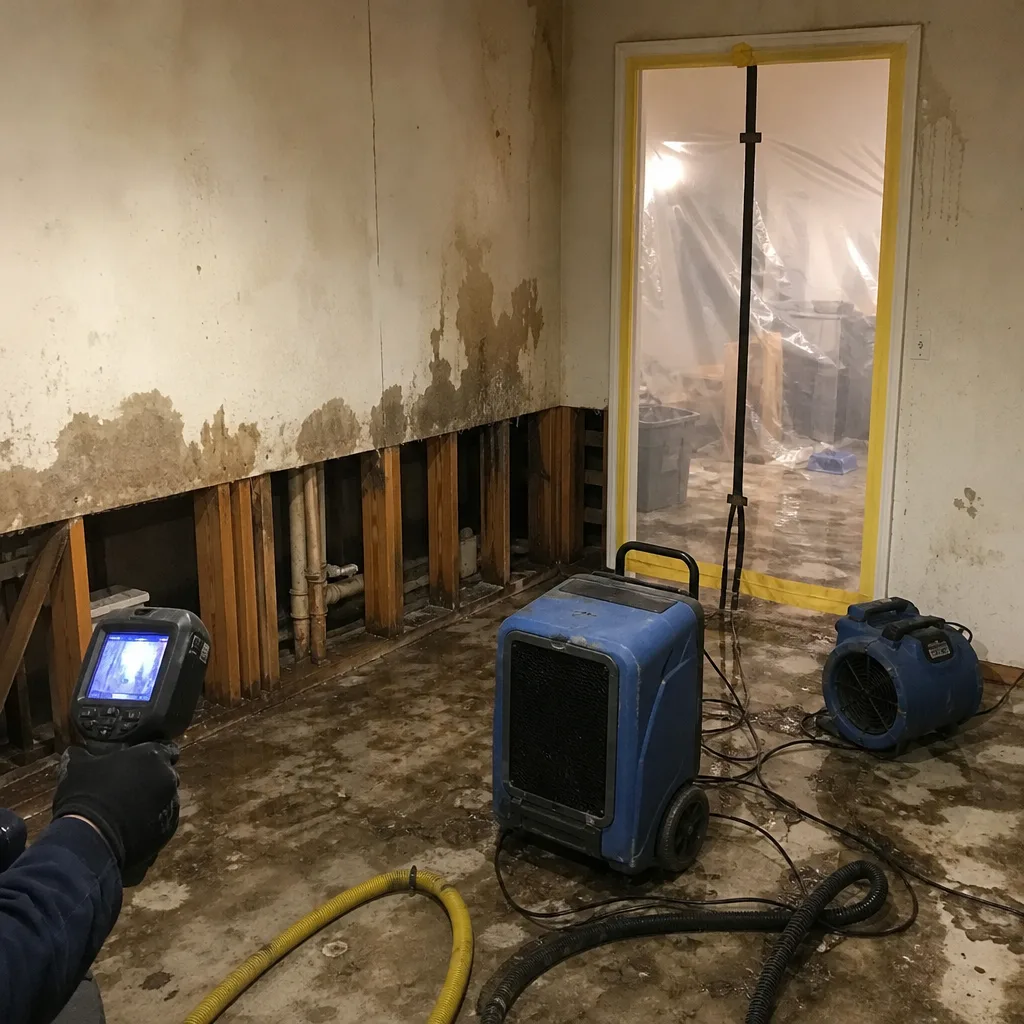
You don’t need a restoration company’s full inventory to gather useful data. Two affordable tools will tell you more than a visual inspection alone. The first is an infrared thermometer, the kind that looks like a small gun and reads surface temperature from a distance. In a conditioned Orlando home, wall and floor surfaces should read within a few degrees of the room’s air temperature. If you find a section of wall that reads 6 to 10 degrees cooler than the surrounding surface, especially on an interior wall nowhere near a vent, that temperature differential often indicates moisture evaporating behind the surface. Evaporation pulls heat from the material, which is why a damp wall patch feels cool to the touch.
The second tool is a pinless moisture meter. These are available for under $50 and read moisture content in wood, drywall, and flooring without poking holes. A dry interior wall in Central Florida typically reads between 5 and 9 percent on the wood scale. A reading above 15 percent at baseboard level on an interior wall is a signal that something is wet. Here’s a simple protocol to follow before deciding whether to call a professional:
- Set the AC to 75 degrees and let it run normally for a few hours. You want the house in its normal conditioned state.
- Walk the perimeter of each room and read the floor at the baseboard line with the infrared thermometer. Note any spots that read more than 4 degrees cooler than the rest of the floor.
- Use the moisture meter on those cooler spots. If the reading is above 12 percent, you likely have an active moisture source.
- Repeat the same routine on interior walls near bathrooms, kitchens, and the air handler closet.
- If you find elevated readings in two separate areas of the same room, call a professional. That pattern suggests a spreading moisture problem rather than a one-time spill.
These measurements are screening tools, not diagnoses. They tell you whether a professional assessment is warranted before paying for one. What they don’t tell you is where the water is coming from, how far it has spread through the wall cavity, or what category of water you’re dealing with. Those answers require training and equipment that follow IICRC standards for water damage restoration, the industry-recognized benchmark for how restoration work is scoped and performed.
Orlando-Specific Warning Signs Homeowners Miss
Orlando’s climate creates warning signs that don’t appear the same way in drier parts of the country. The most misunderstood is the “musty smell that goes away when you open the windows.” In a low-humidity climate, airing out a house can genuinely resolve a mild odor by allowing damp materials to dry. In Orlando’s humid summer, opening windows does the opposite. Outside air at 85 percent humidity moves through the house, contacts the cooler conditioned surfaces, and condenses microscopic amounts of moisture onto walls, floors, and furnishings. The smell “goes away” because you’ve diluted the odor with airflow, but the moisture source behind the wall gets fed, not fixed. The smell returns when the windows close because the mold colony never stopped growing.
Another Orlando-specific signal is persistent condensation on the interior side of windows, particularly in summer. In a properly conditioned home, interior window condensation is rare in warm weather. If you’re seeing water droplets on the inside of double-pane windows in August, indoor humidity is too high, and the source is usually inside the house, not the weather. The third missed signal is specific to block homes and older frame homes with crawl spaces: a persistent “damp concrete” smell in the garage or laundry room that’s strongest in the morning. Block absorbs and releases moisture on a daily cycle in Central Florida. When the smell is continuous rather than periodic, water is being fed into the block from somewhere, often a plumbing leak, an irrigation line, or poor drainage at the slab edge.
What These Signs Cost When Ignored
Price transparency is part of how Dryden Restoration Orlando approaches every job, but more importantly, homeowners deserve to know what they’re looking at before they decide to wait. In the Orlando market, these are realistic ranges for what the warning signs above become when they’re ignored:
- Re-caulking a standard tub or shower: $125 to $250, two hours, done. Ignored for 18 months: shower pan replacement with substrate repair, $2,800 to $6,500.
- Repairing a leaking toilet flange caught in week one: $180 to $350, including a new wax ring and minor floor repair. Ignored for 8 months: subfloor replacement, flooring replacement, and possible mold remediation, $2,000 to $5,500.
- Fixing a condensate drain line that’s backing up: $150 to $275. Ignored through one Orlando summer: damage to the air handler closet floor, possible ceiling damage below, and water damaged drywall, $1,500 to $4,000.
- Drying a small active wall intrusion caught early: $800 to $1,600. Ignored until mold appears: full remediation, drywall replacement, and repainting, $3,500 to $9,000 depending on the spread.
These numbers come from our work across Orlando, from College Park to Conway to Winter Park, and they reflect what we’ve actually billed on scoped, written estimates. The pattern is consistent: the cost multiplies by four to eight times after a year of waiting. That’s the real argument for paying attention to the quiet signals.
Common Mistakes to Avoid
- Painting over active water staining. A coat of stain-blocking primer hides the evidence but doesn’t stop the water. Active intrusion keeps traveling behind the paint, and the damage compounds in a wall cavity you can’t see.
- Using household fans to dry a wet area without removing the damaged material. Fans blow humid air across wet surfaces. In Orlando’s ambient humidity, this can actually spread moisture deeper into the structure rather than drying it out.
- Assuming a small stain means a small source. Water travels horizontally through drywall and subfloor. A stain the size of a dinner plate on the ceiling can originate from a roof leak eighteen feet away.
- Ignoring a door that sticks only in summer. Seasonal binding is a moisture indicator, not a quirk of an older home. Hollow-core doors tell you exactly what your walls and floors are doing behind the finishes.
- Running the AC colder than normal to “dry things out.” A colder setting doesn’t remove more moisture; it just runs longer and raises your electric bill. The problem is a moisture source, not a temperature problem.
- Waiting until you can see mold. Visible mold is a late-stage symptom. The structural damage and the moisture source existed for months before the colony became visible. Treat visible mold as proof of an older problem, not the start of one.
When to Call a Professional
A homeowner can re-caulk a tub, tighten a supply line, and watch a stain for a week. What requires a professional is any situation where the source of moisture isn’t visible, the wet area spans more than a few square feet, or the materials affected include drywall, insulation, or flooring. If your measurements show a moisture reading above 15 percent at the baseboard, or if you have elevated humidity that you can’t trace to an obvious source, you need someone with the equipment to find the water and the training to dry the structure correctly. Dryden Restoration Orlando offers free estimates in Orlando, and every estimate includes a written price before any work starts. Call (850) 786-4472 and describe what you’re seeing. We’ll tell you whether it’s worth a professional visit or something you can monitor on your own.
Frequently Asked Questions
A musty smell after rain in Orlando usually means water is entering somewhere you can’t see, most often through a roof penetration, a window frame, or a crack in the exterior stucco or block. The water wets the wall cavity or attic insulation, and the odor releases as the materials dry. By the time you smell it, mold has usually started growing on the damp material. The right first step is a moisture assessment to find the entry point before the damage spreads.
Touch alone is unreliable. A damp interior wall patch may feel cool, but so will any wall in an air-conditioned home. You need either an infrared thermometer to read the surface temperature differential or a moisture meter to read the material’s actual water content. Both are inexpensive and give you hard numbers instead of a guess. If you don’t want to buy the tools, call us at (850) 786-4472 and we can check it during a free estimate.
A hairline crack in a dry, rarely-used powder room is probably cosmetic. A crack in a shower that sees daily use, especially in a home in Orlando where the ambient humidity stays high year-round, is a genuine risk. Water works through those cracks, saturates the substrate behind the tile, and starts a slow process of mold growth and framing rot that you won’t see until the tile loosens or the odor becomes persistent. Re-caulking and re-grouting are cheap compared to what follows.
In Central Florida’s warm, humid environment, mold can begin growing on damp drywall or wood within 24 to 48 hours of the material becoming wet. That timeline is shorter than in drier climates because the spores need warmth and moisture, and Orlando provides both almost every day of the year. This is why immediate drying with professional equipment matters more here than almost anywhere else.
It depends on the policy language and the source of the leak. Many Orlando policies cover sudden and accidental water damage, like a burst pipe or an overflowing appliance, but exclude or limit coverage for damage from a slow leak that happened over weeks or months. That exclusion is exactly why early warning signs matter so much: the faster you catch it, the more likely the claim falls in the covered category. Document everything with photos, and call your adjuster early. Mold remediation coverage also varies widely by policy, so ask specifically about that coverage before you assume it’s excluded.
Measure the indoor relative humidity with a cheap hygrometer. If your AC holds 45 to 55 percent RH while running normally, it’s doing its job and any excess moisture is coming from an intrusion source. If it can’t hold below 60 percent even when running constantly, the unit itself may be oversized, undercharged, or not draining condensate properly. An oversized AC, common in Orlando homes where contractors over-sized the system, cools the air quickly but doesn’t run long enough to pull out humidity. Fixing that may mean airflow adjustments rather than a new system. Call (850) 786-4472 for guidance on which problem you’re actually solving.
The Bottom Line
The damage that costs Orlando homeowners the most is not the sudden, dramatic incident. It’s the slow, quiet water problem that spent a year moving through a wall cavity while everyone in the house explained the smell away. The signals are there if you know what to look for: soft-edged stains, dark grout that won’t dry, doors that bind in summer, humidity that won’t come down, and cool patches that read wet. Invest forty dollars in a moisture meter and fifteen minutes a month in a walkthrough. When you find something, call someone who will give you a written price before touching a tool. The earlier you catch it, the smaller the number on that paper.
Written by Carl Brandt, Owner at Dryden Restoration Orlando, serving Orlando since 2005.
See the difference
 Before
 After
After Before
 After
After Before
 After
After